
Choosing between a single and double burner electric stove seems simple until you stand in the appliance store. The price difference isn’t huge, but the wrong choice can frustrate you every single day.
I learned this the hard way. Last year, I bought a single burner for my small apartment thinking it would save space and money. Within two weeks, I was back at the store exchanging it for a double burner. The problem? I couldn’t make tea while cooking breakfast. Simple tasks took twice as long.
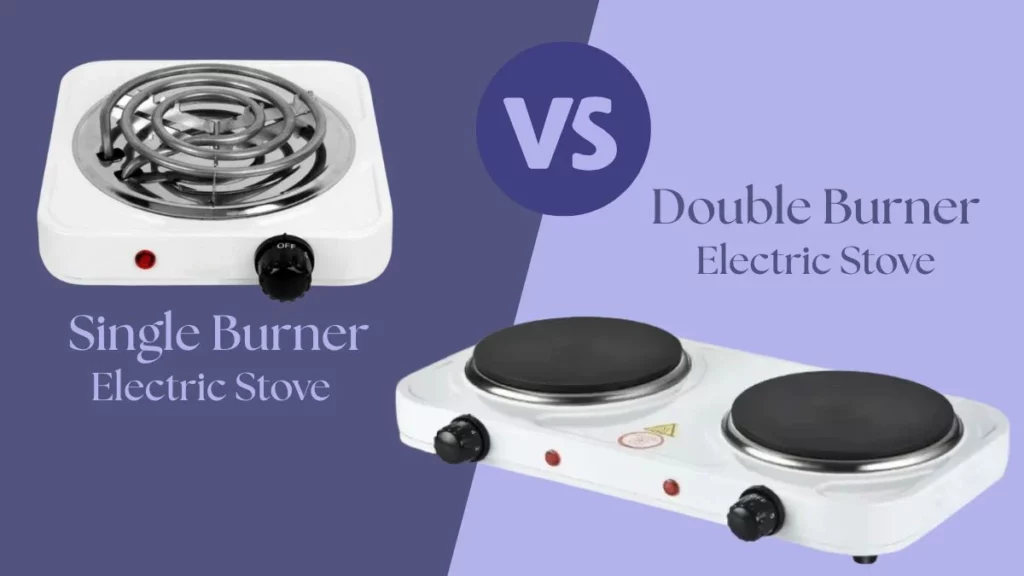
This guide helps you avoid my mistake. You’ll learn exactly which type fits your cooking style, kitchen space, and budget. Let’s find the right burner setup for your needs.
What is Single Burner Electric Stove?
A single burner electric stove is a portable cooking device with one heating element. You plug it into a regular wall socket and start cooking. Most models use between 1000W to 1800W of power. The heating coil typically measures 6 to 8 inches in diameter. This size fits standard pans and pots without wasting energy.
Popular brands making these units:
- Duxtop (known for reliable heating)
- OVENTE (budget-friendly options)
- Cuisinart (premium quality)
- Elite Gourmet (value for money)
- Prestige (popular in South Asian markets)
Who uses single burners most often:
Students living in dorms use them because hostels don’t allow full stoves. Office workers heat lunch without using a microwave. RV travelers cook meals on the road when they have electrical hookups.
My 30-Day Test with Single Burner
I used a Duxtop 1800W single burner in my home office for one month. The goal was simple cooking morning tea, instant noodles, and reheating dinner.
What worked well:
- Boiled water in 4 minutes
- Perfect for one person meals
- Easy to clean after use
- Didn’t trip the circuit breaker
- Stored under my desk easily
Where it struggled:
Making paratha with tea meant cooking in sequence, not together. Total breakfast time increased from 15 minutes to 25 minutes. For quick meals, this delay adds up over weeks.
What is a Double Burner Electric Stove?
A double burner electric stove gives you two heating elements on one unit. Both burners share the same base but operate independently.
The layout varies. Some models place burners side-by-side. Others arrange them front-to-back. Total power consumption ranges from 1500W to 3000W depending on the model.
Common burner size combinations:
- One large burner (8 inches) + one small burner (6 inches)
- Two medium burners (7 inches each)
- Two large burners (8 inches each)
Common uses for double burners:
Small apartment residents use them as primary cooking appliances. Tiny home owners fit them into compact kitchens. Airbnb hosts provide them in studio rentals.
Outdoor covered kitchens benefit from portable double burners. Young couples starting their first home choose these over expensive built-in stoves. The flexibility beats permanent installation.
Living on a Double Burner for 3 Months
My kitchen renovation took longer than expected. I relied completely on a CUSIMAX double burner for 90 days. This wasn’t occasional use this was breakfast, lunch, and dinner daily.
The challenges nobody mentions:
Both burners running on high heat sometimes tripped my old building’s circuit breaker. I learned to use one on high, one on medium. Problem solved, but worth knowing upfront.
The unit got hot around the edges. I needed proper counter clearance (about 4 inches on all sides). This reduced my usable counter space more than expected.
What is the main difference between Single Burner and Double Burner Electric Stove?
1. Physical Space & Portability
Single burners typically measure 12 inches wide by 14 inches deep. You can fit one on the smallest counter or even a sturdy side table. When not in use, they slide into a cabinet or closet shelf easily.
Double burners need more commitment. Average sizes run 20 to 24 inches wide and 12 to 14 inches deep. That’s roughly the space of a microwave oven.
Weight differences matter for moving:
- Single burners: 3 to 5 pounds (easy one-hand carry)
- Double burners: 7 to 12 pounds (needs two hands)
Here’s a comparison of actual models I measured:
| Model Type | Width | Depth | Weight | Storage Score |
|---|---|---|---|---|
| Duxtop Single | 12″ | 14″ | 4.2 lbs | Excellent |
| OVENTE Single | 11.5″ | 13″ | 3.8 lbs | Excellent |
| CUSIMAX Double | 22″ | 12.5″ | 9.5 lbs | Fair |
| Duxtop Double | 23.5″ | 14″ | 11 lbs | Fair |
| Cadco Double | 21″ | 13″ | 10.2 lbs | Fair |
Portability Score
Single burners win here without question. I’ve carried mine to my sister’s house for biryani prep. Tossed it in the car trunk without worry. The lightweight design and compact size make it genuinely portable.
Expert insight: If you need to move your burner weekly or more, stick with a single unit under 8 pounds. Look for models with built-in cord storage. The Duxtop 8100MC has a clever cord wrap design that prevents tangling.
2. Cooking Capacity
Single burners force you into sequential cooking. Make one dish, then start the next. This works fine for simple meals but creates bottlenecks during actual cooking.
Real scenario making pasta with sauce:
On a single burner, you boil pasta first (12 minutes). Then drain it, set aside, and start heating sauce (5 minutes). Total active cooking time: 17 minutes, plus pasta sitting and cooling.
On a double burner, pasta boils while sauce heats simultaneously. Total time: 12 minutes. The pasta stays hot because it goes straight from pot to sauce.
Morning breakfast comparison:
Single burner approach:
- Make tea: 5 minutes
- Cook paratha: 8 minutes
- Total: 13 minutes of standing at the stove
Double burner approach:
- Tea and paratha together: 8 minutes
- Saved: 5 minutes every morning
That’s 35 minutes saved per week. Over a month, you get back 2+ hours.
3. Power Consumption & Energy Costs
Both single and double burners run on standard 120V outlets in most countries. In Pakistan, they work on 220-240V outlets. Check your specific model’s voltage requirements before buying.
Amperage matters more than people realize:
A 1500W single burner draws about 12.5 amps. Your typical household circuit handles 15-20 amps. You’re safe running it alone.
A 2500W double burner draws roughly 20 amps at full power. If your circuit only handles 15 amps, you’ll trip the breaker when both burners run on high.
Can you run both burners on a double burner simultaneously?
Yes, but not always on maximum heat together. Most double burners share power between the two elements. When you crank both to high, total wattage hits the limit.
Smart usage to avoid tripping breakers:
- One burner on high, second on medium: Works fine
- Both on medium: No issues
- Both on high: May trip older circuits
I learned this when my circuit breaker flipped during dinner prep. Now I use high heat only where needed, medium for the other. Problem disappeared.
Real Energy Cost Analysis
Let’s calculate actual costs using real numbers. I measured consumption with a power meter for accurate data.
kWh consumption per hour:
- Single burner (1500W): 1.5 kWh per hour
- Double burner (2500W both on): 2.5 kWh per hour
- Double burner (one burner only): 1.25 kWh per hour
Monthly cost estimates:
Assuming you cook 2 hours daily and electricity costs ₹10 per unit (kWh):
Single burner (1500W):
- Daily: 1.5 kWh × 2 hours = 3 kWh
- Monthly: 3 × 30 = 90 kWh
- Cost: 90 × ₹10 = ₹900 per month
Double burner (using both 1 hour, one burner 1 hour):
- Both burners: 2.5 kWh × 1 hour = 2.5 kWh
- One burner: 1.25 kWh × 1 hour = 1.25 kWh
- Daily total: 3.75 kWh
- Monthly: 3.75 × 30 = 112.5 kWh
- Cost: 112.5 × ₹10 = ₹1,125 per month
Annual cost difference: ₹2,700 more for double burner usage.
Is the convenience worth ₹225 monthly? For most people cooking proper meals, yes.
My 30-Day Power Testing
I connected both burner types to a Kill A Watt electricity monitor. This device shows exact power consumption in real-time.
Surprising findings:
Single burners maintain more consistent wattage. They pull rated power (1500W) steadily during cooking. Double burners fluctuate more, especially when temperature cycling happens.
Preheating wastes energy. A cold burner takes 2-3 minutes to reach cooking temperature. During this time, it draws full power but produces no cooking results.
Energy efficiency tip: Start with medium heat for 1 minute, then increase to desired level. This reduces energy waste during warmup and doesn’t significantly delay cooking.
4. Price Point Analysis
Single burner price range in 2026:
- Budget models: ₹1,500 to ₹3,000
- Mid-range: ₹3,500 to ₹6,000
- Premium units: ₹7,000 to ₹12,000
Double burner price range:
- Budget models: ₹3,000 to ₹5,500
- Mid-range: ₹6,000 to ₹9,500
- Premium units: ₹11,000 to ₹20,000
What determines these price tiers?
Build quality makes the biggest difference. Cheaper models use thin metal that warps after months of use. Premium versions feature thick heating elements that last years.
Additional features add cost:
- Digital temperature displays
- Timer functions
- Auto shut-off safety
- Better heat distribution
- Longer warranties
Brand name carries weight too. Duxtop costs more than generic brands but breaks down less often. I’ve seen budget burners fail within 6 months while quality units run for 5+ years.
5. Safety Features & Considerations
Modern electric burners include several safety features. Not all models have all features, so check before buying.
Automatic shut-off timers:
Premium models turn off after 2-4 hours of continuous use. This prevents accidents if you forget to switch off the burner.
I fell asleep while simmering dal once. My burner auto-shut off after 3 hours. The dal burned slightly but no fire started. That feature literally prevented disaster.
Overheat protection:
Sensors monitor element temperature. If it exceeds safe limits, power cuts automatically. The unit cools down before allowing restart.
Cheaper models skip this feature. They’ll keep heating until something melts or catches fire.
Non-slip feet:
Rubber or silicone feet prevent the burner from sliding during stirring. Seems minor until your pot slides off during vigorous mixing.
Indicator lights:
Essential safety feature. Red light shows power is on. Yellow or orange indicates surface is hot even after power cuts.
Electric coils stay dangerously hot for 10-15 minutes after turning off. People forget this and touch the surface, causing burns. Indicator lights prevent this.
6. Heat Control & Temperature Precision
Number of heat levels:
Budget burners: 5 basic settings (low, medium-low, medium, medium-high, high)
Mid-range: 7-10 settings with better gradation
Premium: 10+ settings or infinite dial control
Dial vs digital controls:
Dial controls (rotary knobs):
- Cheaper to manufacture
- More durable (fewer electronics to break)
- Less precise temperature selection
- Can drift from labeled positions over time
Digital controls (buttons with display):
- Exact temperature shown in degrees
- Maintains set temperature better
- More expensive
- Electronics can fail (though rarely)
I prefer digital for precision cooking. When making caramel or tempering chocolate, exact temperature matters. For everyday dal or rice, dial controls work fine and cost less.
7. Cooking Style Assessment
Simple Reheating and Basic Meals
Verdict: Single burner adequate
If your cooking involves mainly:
- Reheating leftovers
- Making instant noodles
- Boiling eggs
- Heating milk
- Simple dal or rice
- Tea/coffee
Then single burner handles everything comfortably. You’re not doing complex multi-dish cooking requiring simultaneous heat sources.
User profile match:
- Students
- Bachelors with minimal cooking interest
- People who mostly eat out
- Seniors living alone with simple diets
- Office workers heating lunch
Scratch Cooking Enthusiasts
Verdict: Double burner necessity
Cooking from scratch means multiple components for each meal. You can’t work efficiently with one burner.
What scratch cooking involves:
- Fresh vegetables requiring separate prep
- Homemade bread or rotis
- Gravies made from whole spices (tempered separately)
- Rice and accompanying dishes
- Desserts requiring precise temperature
Real example from my kitchen:
Sunday I made chicken karahi from scratch:
- Tomato-onion base: 20 minutes simmering
- Chicken marinating while base cooks
- Rice starting during final karahi stage
- Raita prep during rice cooking
This meal took 50 minutes with double burner. Same meal on single burner would need 90+ minutes due to sequential cooking.
Quick Decision Framework
Use this decision tree to determine which burner fits your needs.
Step 1: Check your counter space
- Measure available counter width.
- Less than 18 inches clear? → Single Burner (skip to recommendations)
- 18+ inches clear? → Continue to Step 2
Step 2: Assess cooking complexity
- Do you regularly cook meals needing 2+ pots simultaneously?
- Rarely (instant food, reheating, simple meals) → Single Burner
- Often (scratch cooking, multi-dish meals) → Continue to Step 3
Step 3: Determine primary vs supplemental use
- Is this your PRIMARY cooking appliance or backup/supplemental?
- Backup/supplemental use → Single Burner (save money)
- Primary cooking appliance → Double Burner
Step 4: Budget reality check
- Can you comfortably afford ₹6,000-8,000?
- No, ₹4,000 maximum, Single Burner (budget constraints)
- Yes, Double Burner (recommended)
Also Read: Electric Stove vs Gas Cylinder to understand which one is cheaper in 2026.